
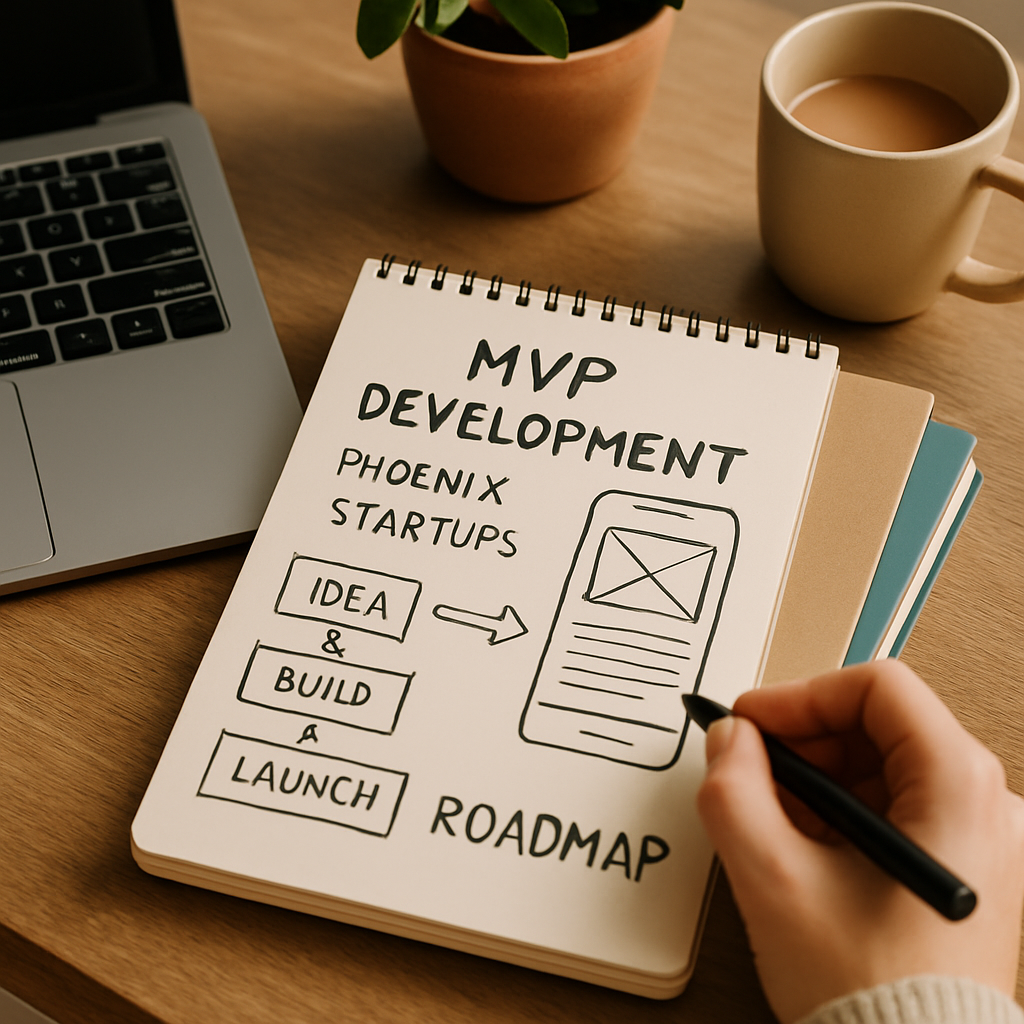
MVP development Phoenix founders actually need looks nothing like the polished playbooks you’ll find on Y Combinator blogs. It’s messier, cheaper, and far more focused on getting one thing right before adding a second. If you’re building from Tempe, Scottsdale, or Downtown Phoenix, you have an interesting advantage: a growing tech scene without Bay Area burn rates.
I’ve watched a lot of local founders pour months into features nobody asked for. This guide is the conversation I wish someone had with them on day one.
What an MVP Actually Is (and What It Isn’t)
A Minimum Viable Product is the smallest thing you can build that proves people will pay for, sign up for, or repeatedly use your solution. That’s it. It is not version 1.0. It is not a beta. It is a test.
Eric Ries, who popularized the term, called it the version of a new product that lets you collect the maximum amount of validated learning with the least effort. Read that twice. The keyword is learning, not launching.
Here’s where I see Phoenix founders trip up: they treat the MVP like a mini version of the dream product. Then they spend $80,000 building a marketplace with reviews, messaging, payments, admin dashboards, and three onboarding flows. None of it gets used because they never tested whether buyers would even show up.
Start With the Problem, Not the Product
Before writing a line of code or signing any contracts, you need to be embarrassingly clear on three things:
- Who specifically has this problem?
- How are they solving it today?
- What would make them switch?
If your answer to #1 is "small business owners," go back. That’s not specific. "HVAC contractors in Maricopa County with 5 to 15 trucks who still schedule jobs on paper" is specific. You can call those people. You can drive to their offices. You can validate.
Talk to at least 20 of them before building anything. Yes, twenty. I know that sounds like a lot. It isn’t. If you can’t find 20 people to talk to about their problem, you definitely can’t find 200 to pay for your solution.
Picking the Right Scope for MVP Development in Phoenix
Once you’ve validated the problem, scope becomes the next battle. The local market here has its own quirks. Construction, real estate, healthcare logistics, and hospitality are huge in the Valley, and those industries have specific workflow expectations.
Your MVP should solve one painful workflow end to end. Not five workflows poorly. One, beautifully.
A good test: can you describe what your MVP does in a single sentence without using the word "and"? If not, cut something.
Some examples I’ve seen work:
- A scheduling tool for pool service routes (just scheduling, no invoicing yet)
- A tenant maintenance request app for Scottsdale property managers (just requests, no payments)
- An AI intake assistant for personal injury law firms (just intake, no case management)
Notice how narrow these are. That’s the point.
Choosing a Tech Stack You Won’t Regret
You don’t need to pick the trendiest framework. You need to pick one that lets you ship in weeks, scale to your first thousand users, and find developers in Phoenix to maintain it.
For most early stage startups, I recommend something boring and proven:
- Frontend: React or Next.js
- Backend: Node.js with Express, or Django if your team prefers Python
- Database: PostgreSQL, hosted on something managed like Supabase or AWS RDS
- Hosting: Vercel, Render, or AWS depending on complexity
- Mobile: React Native if you truly need an app (most MVPs don’t)
If you want a deeper breakdown of how we approach stack selection for early-stage clients, our web and mobile app development services page walks through it. The short version: pick tools your future team can actually hire for.
Avoid microservices. Avoid Kubernetes. Avoid building your own auth. Use Auth0, Clerk, or Supabase Auth. Use Stripe for payments. Use SendGrid for email. Every wheel you reinvent is a month you don’t ship.
Budgeting Realistically
This is where Phoenix has a real edge. A solid MVP built locally typically runs between $25,000 and $75,000 depending on complexity. That’s roughly half what you’d pay a comparable San Francisco agency for the same scope.
Here’s a rough breakdown of where the money goes on a $40,000 MVP:
- Discovery and UX design: $5,000 to $8,000
- Frontend development: $10,000 to $14,000
- Backend and database: $10,000 to $14,000
- QA, deployment, and handoff: $4,000 to $6,000
- Buffer (you will need it): $3,000 to $5,000
If someone quotes you $8,000 for a "full MVP," run. If someone quotes you $250,000, also run. Both extremes usually end the same way: with a product that doesn’t work and a founder who’s out of money.
Timeline Expectations
A focused MVP takes 10 to 16 weeks from kickoff to launch. Anything shorter usually means corners got cut on testing or security. Anything longer usually means the scope crept.
Here’s a realistic timeline:
- Weeks 1 to 2: Discovery, wireframes, technical architecture
- Weeks 3 to 4: Design system and core user flows
- Weeks 5 to 10: Development sprints with weekly demos
- Weeks 11 to 12: QA, bug fixes, security review
- Weeks 13 to 14: Soft launch with 10 to 25 friendly users
- Weeks 15 to 16: Iterate based on real feedback, then open up
The soft launch step is non-negotiable. I cannot stress this enough. The feedback you get from 25 real users in week 13 will save you from rebuilding half the product in month four.
Build, Buy, or Hire? The Phoenix Founder’s Dilemma
You have three realistic paths:
Hire a local agency. Best if you’re non-technical and need a partner who can handle design, dev, and project management. You trade money for speed and reduced risk. Look for shops with a portfolio in your industry.
Hire freelancers and project manage yourself. Cheaper, but only works if you’re technical or have a co-founder who is. Be ready for handoff issues and timezone juggling.
Build it yourself with no-code tools. Tools like Bubble, Webflow, and Glide have come a long way. For very simple MVPs (think internal tools, basic marketplaces, simple dashboards), they can get you to validation for under $5,000. The catch: you’ll likely need to rebuild on real code once you hit scale.
The Phoenix startup community, including groups like StartupAZ and PHX Startup Week, is full of founders who’ve taken each of these paths. Go to a meetup. Ask them what they’d do differently. Most will tell you over a beer.
Common Mistakes I See Phoenix Founders Make
After watching dozens of local MVPs come to life, the same handful of mistakes show up over and over:
- Building before talking to users. Already covered this, but it bears repeating.
- Designing for investors instead of customers. Investors want traction. Traction comes from customers using your product, not from pretty pitch decks.
- Skipping analytics. If you launch without PostHog, Mixpanel, or even basic Google Analytics, you’re flying blind. You need to know what users do, not what they say.
- Hiring offshore to save money, then spending double fixing it. Sometimes offshore works great. Often it doesn’t. Cheap rebuilds aren’t cheap.
- Refusing to charge from day one. Free users are not customers. If people won’t pay $10, they probably won’t pay $100 later either.
After Launch: The Real Work Begins
The day you launch is not the finish line. It’s the starting gun. Plan to spend the next three to six months in tight feedback loops with your earliest users. Weekly calls. Detailed support. Personal onboarding.
Your job in those months is to figure out which 20% of your features drive 80% of the value, then ruthlessly double down on those. Cut the rest. Founders who do this build companies. Founders who keep adding features build feature graveyards.
Once you have product-market fit signals (retention, organic referrals, customers asking to pay more), then you can think about scaling infrastructure, marketing, and the team. Not before.
Wrapping Up
MVP development Phoenix startups can be proud of comes down to discipline more than budget. Talk to users obsessively, scope brutally, ship in months not years, and treat launch as the beginning of the learning, not the end of the project. The Valley has the talent, the cost structure, and the founder community to build serious companies. The question is whether you’ll resist the temptation to build everything before proving anything.
If you’d like to talk through your idea, reach out to our team and we’ll give you an honest read on scope, timeline, and budget. No pitch deck required.
References
- Ries, Eric. The Lean Startup. theleanstartup.com
- Y Combinator Startup Library. ycombinator.com/library
- PostHog product analytics documentation. posthog.com/docs
- StartupAZ Foundation. startupaz.org

