
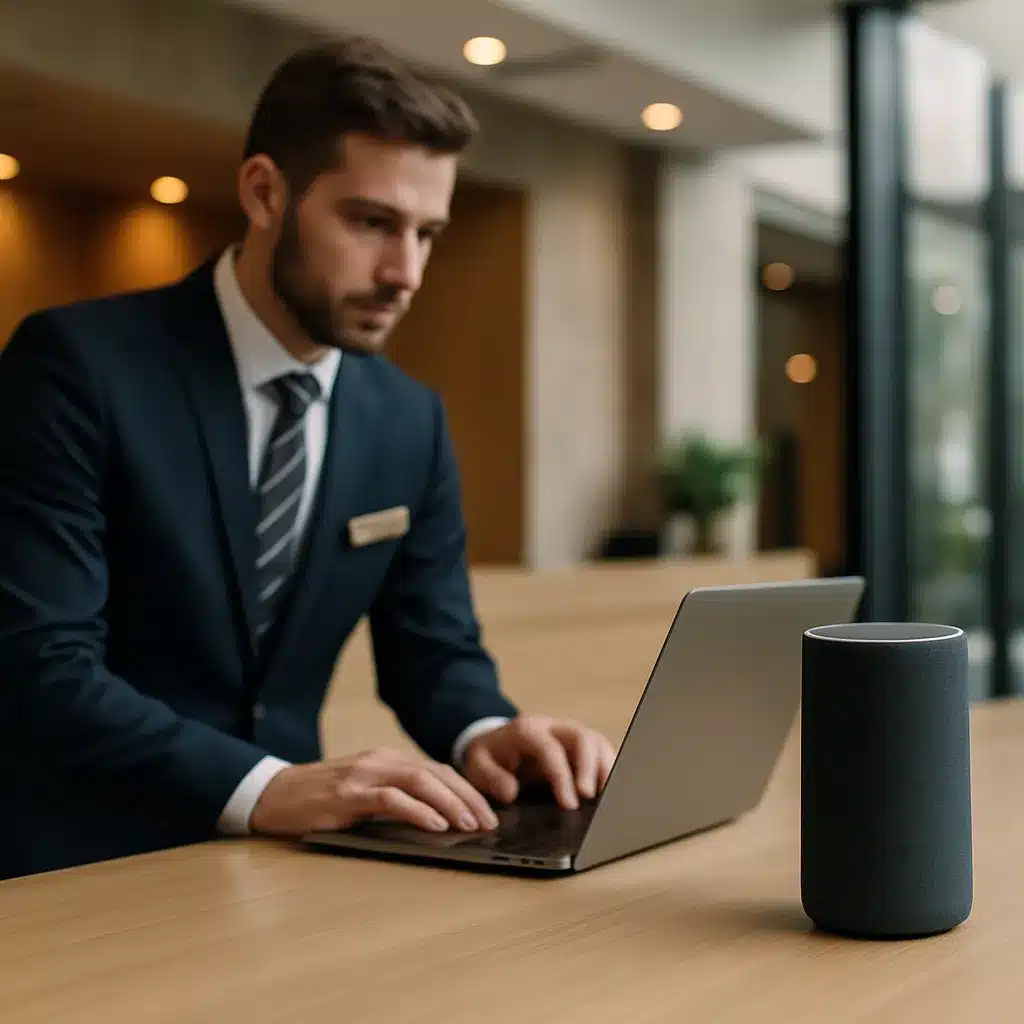
Deploying AI voice agents in a hotel sounds glamorous until a guest at 2 a.m. asks for extra towels and the bot responds with the weather in Reykjavik. That is the real test. Not the demo video, not the vendor pitch deck, but the sleepy guest on floor 11 who just wants towels and quiet.
Hotels are rushing into voice automation this year because labor is tight, call volumes are up, and guests expect instant answers. The problem is most rollouts skip the boring parts. They buy the shiny tech, skip the integrations, and end up with a bot that frustrates everyone. Let’s walk through how to do it properly.
Why Hotels Are Actually Adopting AI Voice Agents
Front desks are drowning. A mid-size property averages 300 to 500 inbound calls a day, and roughly 60% are repetitive: check-in times, pool hours, Wi-Fi passwords, do we have availability for next weekend. Humans burn out answering the same questions. Guests hate hold music.
AI voice agents handle that repetitive layer around the clock without taking a break or getting snippy on hour seven of a shift. They also do something humans physically cannot, which is answer twelve calls at the same time in six languages. For a boutique property with two staff on nights, that is a game changer, oops, that is a huge operational shift.
The real win is not replacing people. It is freeing your human staff to actually look up and smile at the guest standing in front of them.
Pick the Right Use Cases Before Picking a Vendor
This is where most hotels mess up. They ask "what can AI voice agents do" instead of asking "what calls are killing my team." Start with the pain, not the tech.
Good starting use cases:
- Reservation inquiries and bookings during off-hours
- Room service orders and in-room requests
- FAQ handling (pool hours, breakfast times, parking, pet policy)
- Wake-up calls and basic concierge requests
- Post-stay feedback collection
Bad starting use cases:
- Complex complaint resolution
- Medical or safety emergencies
- VIP guest handling
- Anything involving a refund over a certain threshold
Map every call type your front desk receives for two weeks. Tag them by frequency and complexity. The high-frequency, low-complexity bucket is where ai voice agents should live. Everything else routes to a human. Keep that boundary sharp.
Integrations Are 80% of the Work
A voice agent that cannot see your PMS is a very expensive answering machine. Real deployments live or die on integration quality. Your ai voice agents must talk cleanly to your property management system (Opera, Mews, Cloudbeds), your booking engine, your POS, your housekeeping board, and your telephony stack.
If a guest says "add two bottles of water to room 412 and bill it to my room," the agent needs to write that to the POS, trigger a ticket to room service, and log it against the folio. If any one of those steps breaks, you have a confused guest and an angry morning auditor.
Before you sign anything, ask the vendor for a live demo against a sandbox of your actual PMS. Not a slideshow. A live call that moves data. If they cannot show that in week one of evaluation, walk away. The same discipline we recommend for AI appointment scheduling in salons applies here: the booking flow has to touch the system of record in real time or it is theater.
Design the Conversation Like a Human Would Speak
Scripts written by lawyers or marketers sound terrible out loud. Read every prompt aloud before shipping it. If you would never say it to a friend, your bot should not say it to a guest.
Some rules I use:
- Keep agent responses under 15 seconds of speech
- Confirm numbers back ("room 412, correct?")
- Offer a human handoff after the second clarification attempt
- Never pretend to be human if asked directly
- Use the guest’s name once, not seven times
Latency matters more than cleverness. A 400ms response feels alive. A 1.5-second gap feels like the call dropped and the guest will start talking over the agent. Pick a stack that keeps round-trip latency under 800ms end to end. That usually means your speech-to-text, LLM, and text-to-speech providers need to be in the same cloud region as your telephony.
Handle the Edge Cases Guests Actually Throw at You
Guests do not speak in neat sentences. They cough, they have background noise, they switch languages mid-request, their kids scream. Your ai voice agents will meet every one of these in week one.
Build for mess from day one. That means:
- Noise suppression on inbound audio
- Partial-utterance handling so the bot does not interrupt
- Explicit fallback to human after two failed intents
- A clear "press 0 for front desk" at all times
- Logging every call so you can review failures weekly
Keep a weekly review ritual. Pull ten random failed calls, listen to them with your ops manager, and fix the top intent gap. That one habit will do more for guest satisfaction than any model upgrade.
Multilingual and Accessibility Are Non-Negotiable
If you take international guests, you need at least English, Spanish, Mandarin, and one regionally relevant language from day one. Modern voice models handle this well, but you still have to test each one with native speakers. Translation accuracy on hotel-specific vocabulary (folio, concierge, turndown) is often weak out of the box.
Accessibility also matters, both legally and ethically. Guests who use TTY, who have speech differences, or who simply speak slowly should get the same experience. If you need a refresher on inclusive design thinking that transfers nicely to voice, our write-up on accessibility UX wins covers principles that apply directly to conversational interfaces.
Security, Privacy, and PCI Reality Checks
Voice agents at hotels will handle names, loyalty numbers, room numbers, and sometimes credit cards. That last one is where things get spicy. If your ai voice agents take card payments over the phone, you are in PCI DSS scope. Period.
Most mature voice platforms handle this with secure DTMF capture or pause-and-resume recording so the card number never touches your logs or the LLM. Confirm this in writing. Also make sure call recordings are encrypted at rest, access-controlled, and auto-deleted on a schedule that matches your privacy policy. Guidance from the PCI Security Standards Council is the baseline, not a nice-to-have.
GDPR, CCPA, and in some markets biometric voice consent laws also apply. Add a short disclosure at the start of calls: "This call may be handled by an automated assistant and recorded for quality." Short, clear, done.
Measure What Actually Matters
Vanity metrics will fool you. "Calls handled" means nothing if 40% of those guests called back angry. Track the stuff that reflects real outcomes:
- Containment rate (calls resolved without human handoff)
- First-call resolution
- Average handling time versus human baseline
- Guest satisfaction post-call (one-question survey)
- Revenue influenced (bookings created, upsells accepted)
- Escalation reason breakdown
A healthy deployment lands around 55 to 70% containment in the first 90 days, climbing to 75%+ once you tune intents. Anything above 85% and I would be suspicious, you are probably trapping guests who wanted a human.
Rollouts that take data seriously tend to look a lot like the discipline required for restaurant inventory automation, where you only win by watching the numbers weekly and adjusting.
A Realistic 90-Day Rollout Plan
Here is the shape I recommend for most independent and small-chain hotels.
Days 1 to 30: Call audit, use case selection, vendor shortlist, PMS integration proof of concept, voice and persona design.
Days 31 to 60: Pilot on overflow and after-hours calls only. Front desk still owns daytime. Weekly call reviews. Fix top three intent gaps each week.
Days 61 to 90: Expand to full-day coverage for FAQ and reservation flows. Add room service and housekeeping requests. Begin tracking revenue and CSAT impact.
After 90 days, you decide whether to extend into concierge, upsell flows, or post-stay feedback. Do not try to do everything at once. Hotels that stage the rollout get to year one with happy staff. Hotels that boil the ocean quietly turn it off at month four.
Wrapping Up
Deploying ai voice agents for smart hotels is less about the AI and more about operational discipline. Pick narrow use cases, integrate deeply with your PMS, write prompts that sound human, test with real guests, and measure outcomes that matter to the business. Do that and you will have a system your staff actually likes and your guests barely notice, which is exactly the point.
If you want help scoping or building this out for your property, that is the kind of work our team at KuerySoft does every day. Start small, ship something real in 60 days, and let the data tell you where to go next.

