
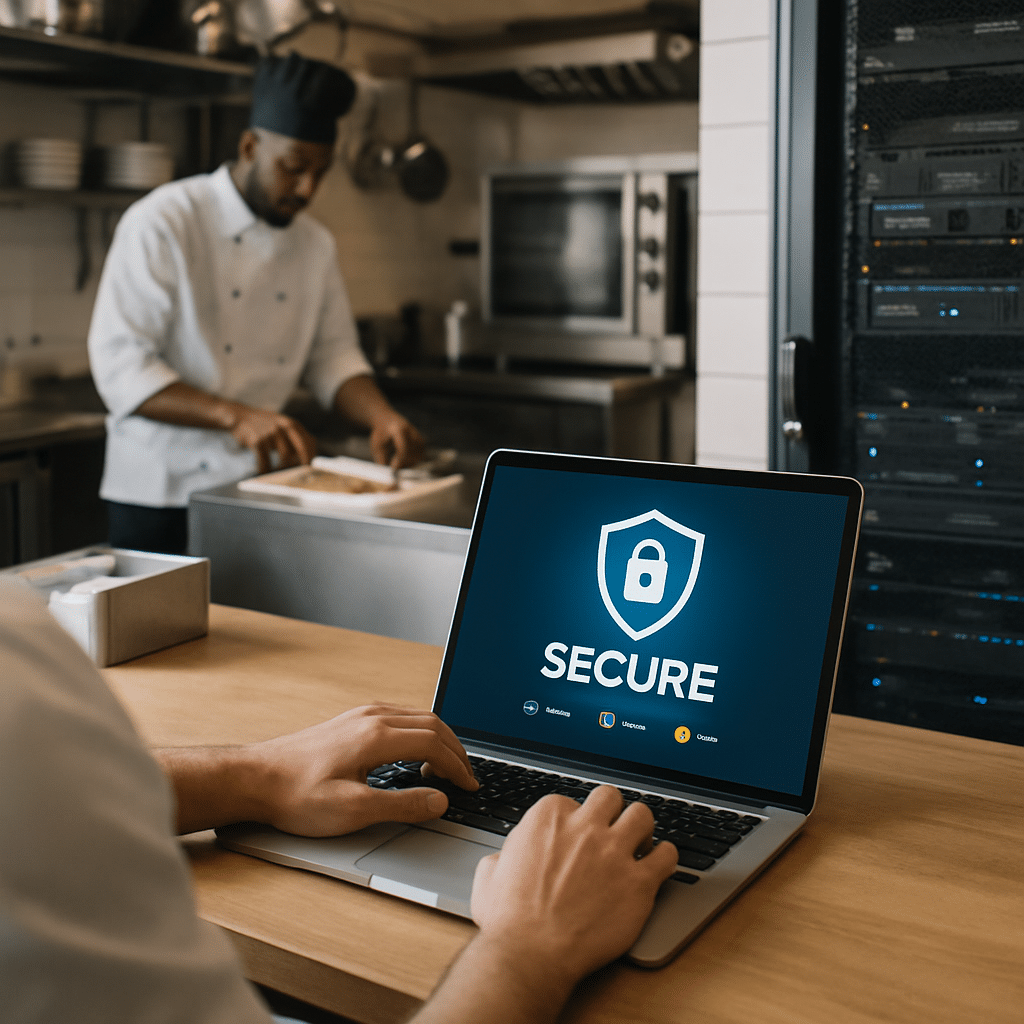
Restaurants have quietly become one of the juiciest targets for cybercrime, which is exactly why ransomware defense belongs on your 2026 operating checklist next to food safety and payroll. Attackers know a busy pizzeria or a 40-location chain cannot afford an hour of downtime, let alone three days. They also know most kitchens run on aging POS terminals, unpatched routers, and a Wi-Fi password shared with anyone who asks nicely.
The last two years have been brutal for the industry. Panera, Krispy Kreme, and several regional chains all got hit, and the average ransom demand for hospitality now sits north of $1.5 million according to recent Sophos data. The good news? Most breaches follow the same handful of patterns, which means a smart operator can block them with practical, affordable moves.
Here are seven ransomware defense wins that actually hold up when someone tries to encrypt your Friday night service.
Segment Your Network So POS Never Touches Guest Wi-Fi
This one is the easiest fix with the biggest payoff. Your point-of-sale system, your back-office computer, your kitchen display, and your customer Wi-Fi should never share the same network. Ever. When they do, one guest clicking a bad link on their phone can hand attackers a direct path to your card reader.
Set up VLANs on your router. Give POS its own isolated network with its own SSID hidden from public view. Guest Wi-Fi goes on a separate segment with client isolation turned on so devices cannot talk to each other. Cameras and smart thermostats? Third segment.
Good ransomware defense starts with the assumption that something on your network will get infected eventually. Segmentation makes sure that "something" cannot spread to the systems that take payments.
Patch Your POS and Back-Office Systems Every Single Month
I know, patching is boring. But roughly 60% of restaurant breaches last year exploited vulnerabilities that had patches available for more than 90 days. That is a solved problem being ignored.
Pick a slow Tuesday morning. Update Windows, update your POS software, update the router firmware, update the security camera NVR. Write it on the manager’s calendar as a recurring task. If your POS vendor tells you patches "might break things," push back hard or find a new vendor. In 2026, that answer is not acceptable.
For chains running custom back-office tools, this is where working with a partner on structured ERP implementation and patch management pays for itself many times over. A managed update cycle beats a scrambling IT contractor at 2 a.m.
Back Up Everything, Then Test That the Backups Actually Restore
Backups are the single most effective ransomware defense tool ever invented, and also the one restaurants get wrong most often. Half the operators I talk to have "backups" that turn out to be a USB drive plugged into the office PC. Guess what ransomware encrypts first? That USB drive.
Follow the 3-2-1 rule. Three copies of your data, on two different types of media, with one copy offsite and offline. Cloud backups from Datto, Veeam, or Backblaze work beautifully for restaurants. Make sure at least one snapshot is immutable, meaning even an admin cannot delete it for 30 days.
Then, and this is the part people skip, actually restore a backup once a quarter. Pretend your POS server just got wiped. Can you rebuild it in under four hours? If not, your ransomware defense plan has a giant hole in it.
Turn On Multi-Factor Authentication Everywhere It Exists
Every remote access tool, every cloud dashboard, every email account, every vendor portal. MFA blocks roughly 99% of credential-based attacks according to Microsoft’s own numbers, and that is the vector most restaurant ransomware attacks start with.
The typical story goes like this. A manager reuses their email password on some random loyalty site. That site gets breached. Attackers stuff the password into your POS vendor’s remote support portal. Two days later, encrypted terminals. MFA breaks that chain.
Use an authenticator app, not SMS. SMS codes can be intercepted through SIM swapping, which is a very real thing in 2026. Google Authenticator or Authy works fine and costs nothing. This aligns with the same principles behind zero trust security frameworks that accounting firms and other regulated businesses have adopted, and restaurants should follow their lead.
Train Your Staff to Spot Phishing (Yes, Even the Dishwashers)
Your line cook probably has your Wi-Fi password. Your host has access to the reservation system. Your GM has admin rights to Toast or Square. Every one of them is a target, and every one of them needs 15 minutes of training a quarter.
Show them real phishing examples. The fake DoorDash "urgent chargeback" email. The fake health department notice. The fake Instagram "your account will be deleted" DM aimed at whoever runs your social. Attackers are creative, and hospitality is now a specific vertical they study.
Run a fake phishing test twice a year using KnowBe4 or a similar tool. When someone clicks, do not punish them. Coach them. The goal is a culture where staff feel comfortable saying "hey, this email looks weird, can you check it?" That single habit prevents more attacks than any firewall.
Lock Down Remote Access and Kill Off Old Accounts
Restaurants have massive turnover. The dishwasher from six months ago, the GM who quit in a huff last spring, the POS vendor’s technician who set things up in 2022, do any of them still have accounts on your systems? Almost certainly yes.
Run an access audit once a quarter. Anyone who does not work there anymore gets deactivated the same day they leave. Vendor accounts get temporary credentials that expire. Remote desktop should be locked behind a VPN or, better, a zero trust access tool like Cloudflare Access or Tailscale.
While you’re at it, disable RDP exposed to the open internet. According to CISA’s ransomware guidance, exposed RDP remains one of the top three initial access methods for ransomware crews. Costs nothing to fix, protects everything.
Get Cyber Insurance and an Incident Response Plan in Writing
You will not stop every attack. Nobody does. What separates restaurants that survive from ones that close is how fast they respond in the first 48 hours.
Buy cyber insurance from a carrier that specializes in hospitality. Coach, Corvus, and Beazley all have restaurant-specific policies now. Expect the underwriter to ask about MFA, backups, and EDR software before they quote you, so having the first six wins in place actually lowers your premium.
Then write down your incident response plan on a single page. Who calls the insurance carrier? Who unplugs the POS servers? Who tells the staff? Who talks to guests? Who handles the press if a local reporter shows up? Print it, laminate it, put it in the office. Rehearse it once a year the same way you rehearse a fire drill. A strong ransomware defense posture is not just tools, it is knowing exactly what happens at minute one, minute ten, and hour six.
Making Ransomware Defense Part of How the Restaurant Actually Runs
Here is the thing nobody wants to say out loud. Most restaurant owners spend more on menu design than on ransomware defense, and then act shocked when a breach eats a month of profits. The seven wins above cost less combined than a decent walk-in cooler repair, and they protect the entire business.
Start with segmentation and MFA this week. Add patching and backups next month. Layer in training, access audits, and insurance over the quarter. By spring you will have a ransomware defense program that most Fortune 500 companies would recognize, running in a taco shop or a fine dining spot without breaking stride. Restaurants that treat ransomware defense as a real operational discipline, not an IT afterthought, are the ones still serving customers in 2027 while their competitors are posting sad Facebook updates about "temporary closures."
If you want help wiring this into your operations, whether that is network segmentation, backup architecture, or staff training programs, that is exactly the kind of work our team handles every day.
References
- CISA, StopRansomware Guide: https://www.cisa.gov/stopransomware
- Sophos, State of Ransomware in Retail and Hospitality 2025: https://www.sophos.com/en-us/whitepaper/state-of-ransomware
- Microsoft Security, MFA effectiveness data: https://www.microsoft.com/security/blog
- FBI Internet Crime Complaint Center (IC3) Annual Report: https://www.ic3.gov/AnnualReport

